
We’re Austin Roofing Company & Water Damage, known as WDR. We’ve been repairing roofs across the Austin metro since 2012, drawing on 25+ years of combined roofing experience, and today hold GAF Master Elite® certification (top 2% of GAF contractors nationwide), BBB A+ accreditation, and 1,510+ five-star Google reviews, the largest count of any Austin roofing contractor. Our crews are W-2 employees, not day-labor subcontractors, and we’re fully insured with general liability plus workers’ comp. On repair calls specifically, W-2 crews matter because targeted repair work depends on installer judgment and experience: a subcontractor rotating through a different crew every week won’t have the accumulated pattern recognition to catch subtle issues.
This page covers when roof repair can’t wait, the specific issues we see most on Austin roofs, our repair process day-by-day, how repair varies by roofing material, the repair-vs-replacement decision, emergency vs scheduled repairs, insurance claim handling, cost drivers, storm assessment timelines, what sets our approach apart, the neighborhoods we serve, and how to schedule your free repair inspection. It’s a long page because roof repair covers a lot of ground, and we’d rather answer your questions here than leave you searching elsewhere.
When Roof Repair Can’t Wait
Some roof problems can wait a few days. Others can’t. The difference matters because delaying the wrong repair can turn a modest fix into a much larger water-damage remediation job. Here’s how we think about triage.
An active leak into the home cannot wait. If water is coming through the ceiling right now, get someone on the roof today, not next week. Water infiltration causes cascading damage: drywall staining, saturated insulation, wood-framing rot, mold growth in wall cavities, and electrical hazards where water crosses circuits. Every day of delay compounds the interior repair scope, which often exceeds the roof repair scope.

Address missing shingles within 3 to 5 days after a wind event. Missing shingles expose the underlayment to UV degradation and the deck to potential water intrusion. Modern synthetic underlayments handle some UV exposure without immediate failure, but the exposed area becomes the roof’s weakest point during the next weather event.
Document visible hail damage within the first week after the storm, even if it doesn’t feel urgent. Insurance policies typically require damage claims within a specific window (often 12 months, sometimes shorter depending on carrier), and adjuster availability tightens dramatically in the weeks after a major hail event as the whole metro competes for inspections.
Suspected flashing failure at a chimney, sidewall, or dormer can usually wait 2 to 4 weeks unless there’s active leaking. Flashing issues rarely cause acute water intrusion, but they can cause chronic slow leaks that show up as ceiling stains months later.
Aged shingles with widespread granule loss or curling don’t need emergency response, but they do call for a professional inspection to determine whether a targeted repair extends the roof’s life or whether it’s time to plan replacement. That decision depends on the wear pattern across the roof, not just the shingles’ age.
Common Roof Repair Issues in Austin
The Austin metro’s climate mix (heat, wind-driven rain, occasional hail, freeze events every few years) produces a predictable set of roof problems. Here are the ones we handle most often.
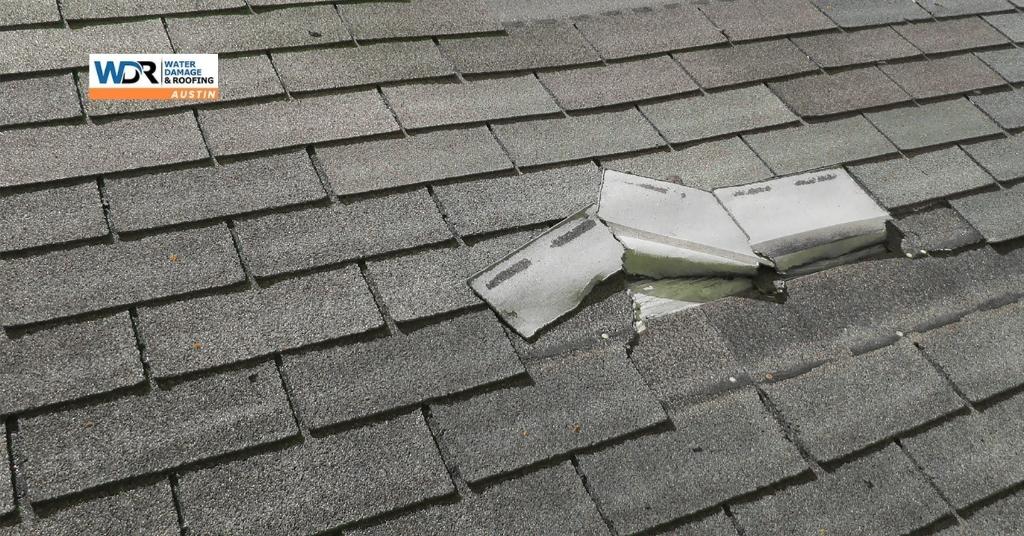
Missing or lifted shingles after wind events
Austin gets 60+ mph wind gusts during severe thunderstorms and occasional straight-line wind events. Shingles rated for 130 mph handle those without lifting when properly installed. Under-nailed or improperly installed shingles can lift or tear off entirely. The visible damage is usually a handful of missing shingles at the leading edge of the wind direction. Repair scope depends on how widespread the damage is: 1 to 10 shingles is a targeted patch, 10 to 30 is a section repair, and more than that starts approaching the cost of full replacement.
Hail damage (impact bruising)
Hail damage on asphalt shingles typically appears as small round bruises where impact fractured the shingle mat beneath the granule surface. From the ground, hail damage is often invisible; from the roof at close inspection, the bruises are obvious. Class 4 impact-rated shingles resist hail damage; standard architectural and 3-tab shingles usually don’t. Insurance carriers treat hail damage as a covered peril and pay to repair or replace damaged shingles, often with like-kind quality.
Flashing failure (chimneys, sidewalls, penetrations)
Metal flashing at chimneys, sidewalls, dormers, pipe boots, and skylight penetrations is a common leak source, especially on roofs 10+ years old. Original flashing sealants degrade, metal fasteners loosen, and gaps develop that let water past the shingle line. Flashing repair is typically a targeted intervention: replace the failed flashing, reseal, and re-integrate with the surrounding shingles. Rarely requires replacing large sections of the roof.
Roof penetration leaks (pipe boots, vents)
Pipe boots (the rubber collars around plumbing vent stacks) and roof vent bases fail predictably as they age. Rubber cracks, plastic warps, sealant deteriorates. These are cheap and fast to fix but often go unnoticed until an interior ceiling stain appears. Any repair inspection should check the condition of every roof penetration boot.
Underlayment failure (typically discovered during other work)
The underlayment beneath the shingles is the secondary water barrier. If it fails while the shingles are still intact, water can penetrate the deck without visible surface damage. You usually discover underlayment failure during a targeted repair for something else, or when persistent slow leaks lead to a full roof inspection. Repair typically requires removing shingles in the affected area to replace underlayment beneath.
Improper prior repairs
We’re often called to inspect roofs that received prior repair work from other contractors and are now leaking or showing problems in the repaired area. Common issues: patch shingles that don’t match the field color, improper flashing integration, sealant applied instead of proper metal work, cut field shingles used where matching ridge caps were needed. These usually require redoing the prior repair with proper technique.
Our Roof Repair Process
Every repair we do follows the same underlying process, scaled to the job’s size and complexity. Here’s what to expect.
Step 1: Initial phone or web inquiry. You describe the problem; we ask a few triage questions (is water currently coming in, when did it start, do you have insurance involvement), and we schedule the on-site inspection. Most inspections happen within 24 to 72 hours of the initial contact for non-emergency repairs, and same-day for active leaks.
Step 2: On-site inspection. Our estimator arrives at the scheduled time (we call ahead when we’re 30 minutes out), does a full exterior and rooftop inspection, and documents findings with photos. If the problem is straightforward, we can quote right there. If insurance is involved or the scope needs more evaluation, we send the written estimate within 48 hours.
Step 3: Written estimate. The estimate lists the specific work required, the materials to be used (brand and product line for shingles or flashing), the labor scope, and a timeline. If we’ve identified additional issues beyond the initial complaint (which is common on older roofs), those are called out separately with a recommendation on whether to address them now or later.
Step 4: Scheduling and work. Once you approve the estimate, we schedule the work. Most targeted repairs are completed in a single day. Larger scope work takes 2 to 3 days. Weather delays happen, and we’ll reschedule rather than work in unsafe conditions.
Step 5: Warranty and documentation. All our workmanship carries a 5-year warranty. Materials carry the manufacturer’s warranty (typically the full shingle warranty on any replacement shingles used). We provide photo documentation of the completed work and the warranty paperwork.
Roof Repair by Material
Repair approach varies significantly by roofing material. Here’s how we handle each type.


Asphalt shingle repair
Asphalt is the most-repaired material by far because it’s the most-installed material in Austin. Targeted asphalt shingle repair replaces individual damaged shingles course by course, matching manufacturer, product line, and color as closely as possible. The critical constraint is matching: shingles in place for 5+ years typically weather slightly, and even the same manufacturer’s product may not match perfectly out of a fresh bundle. On roofs where matching is important (highly visible from the street), we sometimes source replacement shingles from a less-visible section and use fresh shingles in the less-visible location. Our asphalt shingle repair page covers the material-specific details.
Tile roof repair
Tile repair is fundamentally different because each tile is an individual unit that can be replaced without disturbing surrounding tiles. For broken tiles, we unhook them from the batten, replace them with matching tiles from spare stock (if available) or newly sourced tiles, and re-secure them. The critical constraint on tile repair is matching: tile installed 20+ years ago may no longer be manufactured in the exact profile and color. Homeowners with tile roofs should keep a small stock of the exact tile used in their installation to handle future repairs.
Metal roof repair
Standing seam and metal panel roofs rarely need shingle-style repairs because they don’t have individual small units to replace. Metal roof repair typically addresses fastener failures at panel seams, sealant failures at penetrations, damaged panel sections after storm impact, or flashing failures at valleys and roof-to-wall transitions. Metal repairs require metal roofing experience, not general shingle installation experience, because the panel-to-panel and panel-to-flashing interfaces have specific technique requirements.
Flat roof repair (TPO, EPDM, modified bitumen)
Flat commercial roofs use single-ply membrane systems that are repaired with membrane patches, seam re-welding (on TPO/PVC), or new membrane sections. Our commercial repair work handles TPO, EPDM, and modified bitumen membranes on retail, office, and small industrial buildings across the Austin metro. Flat roof repair often requires specialized equipment (hot-air welders for TPO, torches for modified bitumen) that residential shingle crews don’t carry.
Repair vs Replacement, How to Decide
This is the single most important question on any roof more than 15 years old. Repairing when replacement is the right answer wastes money on a roof that’ll need full replacement soon anyway. Replacing when targeted repair would extend life 5 to 10 more years wastes money on premature replacement. Here’s how we think about the decision.
Repair typically makes sense when: the roof is under 15 years old with damage limited to a specific area, storm damage is localized rather than widespread, the underlying underlayment and deck are still in good condition, and the roof’s remaining life (5+ years) justifies the repair investment. In these cases, a targeted repair extends useful life without accelerating replacement. If a subsequent inspection shows the repair held and the surrounding roof is aging normally, waiting to replace makes financial sense. Our roof replacement assessment page covers what a replacement quote looks like when the decision goes that direction.
Replacement typically makes sense when: the roof is 20+ years old, and problems are appearing in multiple areas, hail or wind damage is widespread rather than localized (insurance often triggers full replacement when damaged areas exceed a threshold percentage of total roof area), the underlayment is failing beneath still-intact shingles, or the roof is at the end of the manufacturer’s warranty life. In these cases, patching individual problems delays the inevitable and rarely extends useful life meaningfully. Our roof installation team handles both replacement and new-construction installations if that’s the direction.
The borderline cases are the hard ones. A 15- to 18-year-old roof with moderate damage in one section could go either way. Factors that push toward repair: you plan to sell within 3 years (buyer inspection will identify the roof condition regardless), budget is constrained, damage is genuinely localized. Factors that push toward replacement: you plan to stay 10+ years, hail damage is documented across more than 25% of the roof, insurance covers a significant portion of the replacement cost, or your current shingles are past the manufacturer’s warranty and any repair won’t carry warranty protection.
We’ll give you our honest assessment during the inspection. We don’t push replacement when repair is the right answer, and we don’t accept repair work when we know the roof will need replacement within a year or two.
Emergency Repair vs Scheduled Repair
Not every repair is an emergency, and not every emergency call is really an emergency. Understanding the difference helps you avoid emergency-service premium pricing when it isn’t warranted and get help fast when it actually is. Our emergency roofing services handle true emergencies (active water intrusion, storm damage during severe weather, structural failures) with same-day response.
Emergency repair applies when active water is entering the interior of the home, when a large section of the roof was compromised during a recent storm and rain is forecast in the next 24 hours, or when structural failure has occurred (partial collapse, exposed framing damage). In these cases, we prioritize response over cost optimization: a temporary tarp installation to stop water intrusion buys you time until proper repair can happen in daylight and dry conditions.
Scheduled repair applies when the problem is real but not actively causing damage. Missing shingles from last week’s wind that haven’t caused any leaks yet, flashing that’s leaking during heavy rain but not during normal weather, hail damage that just got documented but isn’t currently causing water intrusion. We inspect these within a few days and repair them within 1 to 2 weeks, depending on scope and scheduling. Scheduled repairs cost less because we can plan the work properly, get materials at normal pricing, and complete the job in ideal weather.
When in doubt, call and describe what’s happening. We’ll help you understand which category your situation falls into.


Insurance Claims for Roof Repair
A significant portion of our repair volume follows storm events when insurance pays for some or all of the repair. Here’s what we’ve learned from handling hundreds of Austin-area insurance claims for repair work.
Timing matters. Most policies require damage reporting within a specific window after the loss event (often 12 months, sometimes shorter). Waiting to file gives the insurance company more grounds to dispute causation: was the damage really from that storm, or from an earlier undocumented event? We recommend documenting damage with photos and calling your carrier within 30 days of any suspected damage event.
Adjuster access. When your carrier sends an adjuster, we can meet them on-site if you request it. Having a roofer on the roof with the adjuster ensures nothing gets missed, questions get answered accurately, and you have someone advocating for proper documentation of all damage. Some carriers will ask you to have an estimate from a roofing contractor before sending an adjuster; others prefer to inspect first. Either way works.
Scope negotiation. Adjusters and roofers occasionally disagree on repair scope. Common disagreements: whether damage is from the reported storm event or from pre-existing wear, whether repair is sufficient or full replacement is required, whether like-kind replacement means matching the exact damaged shingle or accepting a similar product. We handle these negotiations for you when we’re the retained contractor, and most disagreements resolve without escalation.
Deductibles. Your policy deductible applies regardless of whether it’s a repair or replacement. On repair scopes, if the total cost is less than your deductible, insurance pays nothing, and you pay the full cost out of pocket. This is why very small repairs typically don’t go through insurance at all. Larger repairs where the cost exceeds the deductible are worth the claim.
Depreciation and recoverable depreciation. Insurance settlements typically calculate actual cash value (ACV) first, which subtracts depreciation from replacement cost value (RCV). You receive the ACV up front, plus recoverable depreciation once the work is completed. This means you may need to advance some funds before the full settlement lands. We can walk through this at the estimate stage so there aren’t cash-flow surprises.
What Affects Roof Repair Cost
We don’t publish specific repair prices on this page because repair costs vary too much from project to project. Here are the drivers so you can compare estimates apples-to-apples.
Scope of damage. A single missing shingle costs a small fraction of a section repair. A section repair costs a fraction of a partial-roof replacement. The bigger the affected area, the higher the total cost, though per-square costs sometimes decrease at larger scopes due to mobilization efficiency.
Material matching difficulty. If your shingles are current-production and easy to source, repair materials cost the same as new shingles. If your shingles are discontinued or specialty products, sourcing matching materials may require ordering from distributors or accepting close-match alternatives. This affects both cost and timeline.
Roof access and complexity. Simple single-story gable roofs are the fastest and cheapest to repair. Two-story roofs, steep pitches, complex hip-and-valley geometries, and roofs with obstructing features (solar panels, ornate architectural elements) increase labor time and safety equipment requirements.
Underlying issues discovered. Sometimes what looks like a simple repair reveals additional damage once we get on the roof: rotten decking beneath the shingles, failed flashing beneath what appeared to be a straightforward wind damage repair, or insufficient underlayment that needs replacement alongside the shingles. Good repair estimates anticipate this possibility and include contingency language for common scenarios.
Insurance vs. cash-pay. Insurance-covered repairs typically cost more than cash-pay repairs of equivalent scope because insurance work involves additional documentation, adjuster coordination, and often requires specific material tier matching. This isn’t price gouging: it’s real additional work. Cash-pay repairs at your discretion allow more flexibility on materials and scope.
Warranty tier of replacement materials. If your repair uses materials that qualify for extended manufacturer warranties (GAF Golden Pledge, similar), material costs are higher than economy alternatives, but the coverage is meaningful.

Storm Damage Assessment Timeline
After a significant storm event in the Austin metro, the assessment and repair timeline follows a predictable pattern. Understanding this helps you plan and avoid getting swept up in the post-storm chaos.
Days 1 to 3 post-storm: focus on preventing additional damage. If active leaks are present, temporary tarps buy time. Document visible damage with photos from ground level. Don’t climb on the roof yourself unless you have specific training: wet or damaged roofs are dangerous.
Days 3 to 7 post-storm: schedule the professional inspection. Legitimate roofing contractors will be busy but should still respond within this window to assess damage. Be cautious of storm-chaser contractors who show up at your door with same-day pressure tactics; legitimate local contractors don’t operate that way.
Days 7 to 30 post-storm: file the insurance claim if damage warrants it. Get a written estimate from your chosen contractor, submit to the carrier, schedule the adjuster visit. Adjusters get backed up significantly in the weeks after major storm events, so scheduling early matters.
Days 30 to 90 post-storm: repair or replacement work completes. Contractor scheduling gets tight after major events because everyone in the affected area is trying to book the same crews. Wait times of 4 to 8 weeks aren’t uncommon for non-emergency work following major storms.
Days 90+: any latent damage that took time to appear (slow leaks, cosmetic issues, minor problems that weren’t initially obvious) should be reported and addressed. Insurance claims typically stay open long enough to cover this period.
What Sets WDR Apart on Repair Work
What sets our repair work apart comes down to who’s doing the work and how we approach the diagnosis. We’ve operated from the same 9711 Beck Cir address in Austin since 2012, drawing on 25+ years of combined roofing experience across the team, which matters on repair work specifically because the same team sees the same neighborhoods and the same recurring problems across seasons. Some of it also comes from the specific expertise that living with Austin’s climate for 14+ years gives us. If you want to see our approach to the underlying materials themselves, our asphalt shingle expertise page covers the product-line depth we bring to shingle work specifically.

W-2 crews, not day-labor subcontractors. This matters most on repair work where installer judgment about subtle issues determines whether the repair holds for 5 years or fails within one. Our crews have accumulated pattern recognition from thousands of Austin roofs. Rotating subcontractor crews don’t build that knowledge base.
GAF Master Elite® certification (top 2% of GAF contractors nationwide). Even for repair work using materials from other manufacturers, the training and quality standards required to hold Master Elite status transfer to how we approach any roofing work.
1,510+ five-star Google reviews, the largest count of any Austin roofing contractor. That review count reflects consistent workmanship across a long time window, not a few good months.
BBB A+ accreditation, maintained continuously since our founding. This means we have a documented record of resolving customer concerns properly rather than accumulating unresolved complaints.
Fully insured with general liability and workers’ comp. Certificate of insurance available before contract signing. This protects you if anything goes wrong during the repair work: our insurance covers property damage, injury, or subcontractor claims that would otherwise flow to you.
Insurance claim expertise. We’ve handled hundreds of insurance-covered repair projects and know how to work with adjusters, document damage properly, and negotiate scope when disagreements arise. On insurance work specifically, this expertise often changes the outcome by thousands of dollars.
Local Austin knowledge. We know which neighborhoods have specific building code requirements, which HOAs restrict shingle colors or materials, and how Austin’s weather patterns affect long-term roof performance. That local knowledge doesn’t transfer from generic national roofing chains.
Where We Serve
Our primary service area is the Austin metro and surrounding Central Texas Hill Country. Our Cedar Park roofers cover Cedar Park and adjacent areas. Our Round Rock roofing team covers Round Rock, Williamson County, and the northeastern metro. We serve homeowners throughout the region, including but not limited to these areas.
Central Austin: Downtown, Zilker, Tarrytown, Clarksville, Rosedale, Hyde Park, Bouldin Creek, Travis Heights, and adjacent neighborhoods.
North Austin: Crestview, Allandale, North Loop, Wooten, Highland, Windsor Park, University Hills, and adjacent areas.
South Austin: Brentwood, South Congress, Barton Hills, South Manchaca, Onion Creek, Slaughter Lane corridor.
West Austin: West Lake Hills, Rollingwood, Bee Cave, Lakeway, Steiner Ranch, Lake Travis area, and the Hill Country west of the metro.
Suburban and outlying areas: Round Rock, Cedar Park, Leander, Georgetown, Pflugerville, Manor, Kyle, Buda, Dripping Springs, Lago Vista, Jonestown, Wimberley.
If your area isn’t listed, call and ask. We regularly do work outside our typical service map, especially on larger commercial or specialty projects.
Getting a Roof Repair Estimate
The first step is a free on-site inspection. Call (512) 820-6505 or use the estimate request form on this site. We’ll ask a few triage questions to understand urgency and scope, then schedule the inspection at a time that works for you.
During the inspection, our estimator does a full rooftop and interior review, documents findings with photos, and either quotes you on the spot for straightforward work or sends the written estimate within 48 hours for more complex scopes. If insurance is involved, we can coordinate with your adjuster and provide the documentation your carrier needs.
The estimate itself is written, itemized, and lists the specific work required, materials to be used, timeline, and warranty terms. We don’t do verbal quotes or handshake deals. Everything gets documented so both sides are clear on what’s included.
There’s no obligation from the estimate. If you decide to go with another contractor, or to defer the work, that’s fine. If you want to proceed, we schedule the work and get started, usually within 1 to 3 weeks depending on scope and current booking.